The Case of the Summer Literature Machine – can automation take away creativity?
October 30, 2025
The AI debate in the creative industries is currently dominated by an optimistic view in which the machine is seen as a human’s creative partner. Research widely discusses co-creation, a model in which AI acts as a sparring partner that offers new ideas and the human creator retains their role as the creative leader who guides the process (Kadenhe et al., 2025). In this chapter, I present my personal project, the Summer Literature Machine, which was born to challenge the idea of co-creation. I wanted to explore what happens if AI does not assist, but is used to automate the creative process in its entirety—and what that reveals about the fundamental difference between human and machine creativity.
My idea of generated literature is by no means entirely unique. As early as 1953, Roald Dahl presented a similar idea in his short story “The Great Automatic Grammatizator,” which is strikingly reminiscent of today’s language models (Lipping & Ahonen 2025) In the United States, a 2023 survey by the Authors Guild shows that 67% of writers feel AI threatens their income, and 70% think publishers will start replacing human authors with AI writers. For example, Amazon already contains large numbers of books generated in one way or another, but in Finland’s popular audiobook and reading subscription services there are still very few. The best known is probably Storytel’s AI author Rosy Lett, an AI writer under whose name Storytel has published a few short stories generated entirely by AI. Still, in literature there are fewer documented examples of creating a whole book. For a long time it has been considered challenging, because a full novel has exceeded the size of language models’ context window—meaning the whole has not remained coherent and thus high-quality.
AI has, of course, been used a great deal to edit texts. Many have used AI to generate ideas, and many have also tried using a language model to polish texts. After all, the proofreading in word processors is a similar solution. With large language models, this has happened even more effectively.
But if AI can improve a human’s text, why couldn’t it also improve its own text? On that basis, I started coding software that would produce a finished book using language models. I broke the author’s work into separate tasks, which I assigned to different AI models: one acted as the writer (Claude Sonnet 4), another as the critic (Grok 4), and a third as the copy editor (Gemini Pro 2.5), and the whole process was guided by an orchestrating “Author-model.” The end result was the sum of a dialogue between several AI agents.
I fed the machine a sci-fi idea given by a friend and added only one sentence: “But still a happy ending.” After about one workday, I had a finished novel in my hands, Blank Page .
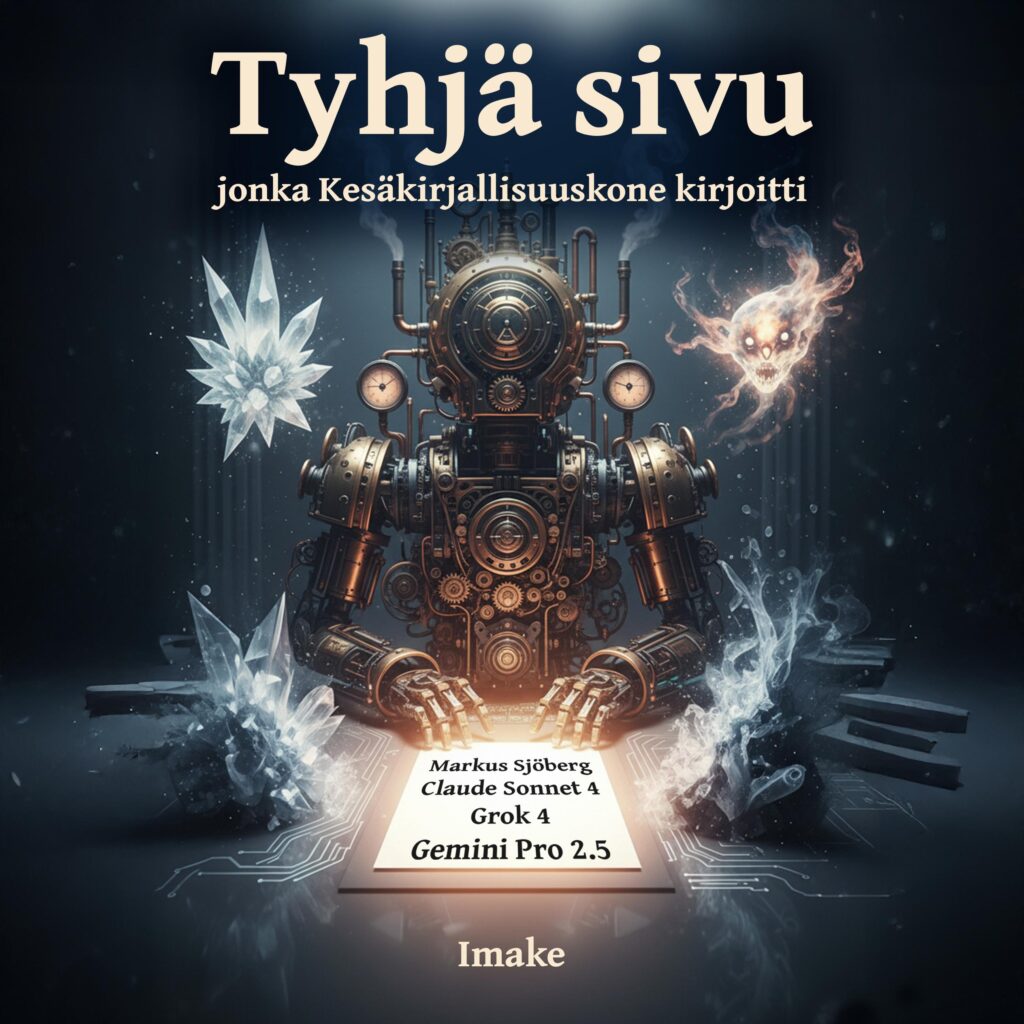
The end result was surprisingly high-quality. The novel was coherent, and its meta level—a story about its own creation process—brought with it narrative layers of its own.
For me, the process also produced food for thought. Even though the work was technically functional, it was not my text at all. I was the developer of the machine, not the writer. I have written prose as a hobby and published a couple of self-published books. I’m not saying they are inherently better than AI-made literature, but they are my own thinking. I have condensed into them my life experience, my reflections, and on the other hand a lot of things viewed through the lens of skewed satire—something AI could hardly even reach. Even if writing a book can be automated, it is not, at least for me, something I would consider a particularly good thing. If more and more books are generated, finding my works among them becomes even harder. And it must be said that for a self-published author, it isn’t too easy even at this moment.
Ultimately, the reason I haven’t started churning out dozens of AI novels onto the market is simple: writing is enjoyable. Writing—and thinking conveyed through writing—creates experiences of meaningfulness. The case of Blank Page proves that, at least in one case, AI reduced the amount of literature written by a human—it gave me an excuse to postpone starting my next novel.
The Summer Literature Machine shows that full automation is a real threat to creative work, not just a distant scenario. It can flood the market with generic content and make creative professions even less profitable. At the same time, however, it clarifies why human-made art is irreplaceable. We don’t read books or watch films just to get well-structured content. We seek a connection to another person—to their thoughts, feelings, and unique way of experiencing the world.
As the amount of generated content grows, it becomes increasingly important that we find, among it all, the gems that contain new and interesting ideas. The ones that challenge generic entertainment with an original approach. We may also need AI’s help for that.
The growing need for curation
The need for curation did not arise with generative AI. It has always been part of the cultural field. Art exhibitions are probably the most familiar dimension in which curation is present, but it also touches the broader cultural sector. Publishers and production companies have acted as gatekeepers of quality.
With social media, curation has increasingly taken place through the power of algorithms. Algorithms choose what we are shown. Everything usually happens automatically, without the user being able to influence—at least not fully—what they see.
More and more often, the curation performed by algorithms uses AI, such as language models, as assistance. Social media services have an ever better understanding of what each piece of content contains and can recommend to you exactly what you spend the most time with. Anyone who has used social media is likely familiar with where this development has led. Social media feeds are rarely full of high-quality content and inspiring ideas. Instead, fast, pre-chewed entertainment is at the center.
Some services, such as Meta’s Facebook and Instagram, have shifted to offering more and more content in their feeds that does not come directly from the user’s networks, but is instead content that is trending on social media. In these cases, you increasingly run into content that is AI-generated—or at least you cannot be sure of its origin. Meta is even developing ways itself to increase the amount of generated content in its services.
Although development has moved day by day further away from intelligent and compelling human-produced content, it is also possible to use algorithms to do curation that would bring human-made, high-quality content to the center. Although there are still few such solutions, and they are not yet found in mainstream services, it is possible that, as a counterbalance to the growing amount of AI-generated content, recommendation algorithms will begin to be used to highlight high-quality, human-driven content from the mass. At least it is technically possible.
The article was originally published in the LuovAIn! project’s online course Generative AI in creative work